

If your message needs explaining, it’s not fit for purpose
When leaders start “unpacking” announcements, the message is broken. Complexity isn’t sophistication—it’s a neon sign that leadership can’t say what it means.


Some corporate communication teams have a superpower. Not a good one - more like a Marvel villain whose power is making everything 40% more complicated. Hand them a simple idea, and they will transform it into a three-slide acronym, a twelve-step cascade pack, and an internal microsite no one asked for.
The result is a familiar corporate tragedy: messages that require explaining.
If you’ve ever seen a town-hall where the CEO says, “Let me unpack this,” you already know the message has failed. Messages shouldn’t need unpacking. If employees need a decoder ring, you don’t have a communication problem - you have a clarity problem disguised as one.
And the evidence is very clear. Behavioural economics research shows that once a message takes more than about 12 seconds of cognitive processing, retention drops significantly. That’s not a small dip — that’s catastrophically signal loss.
Think about that. If your message takes longer than reading a cereal box, your workforce mentally checks out.
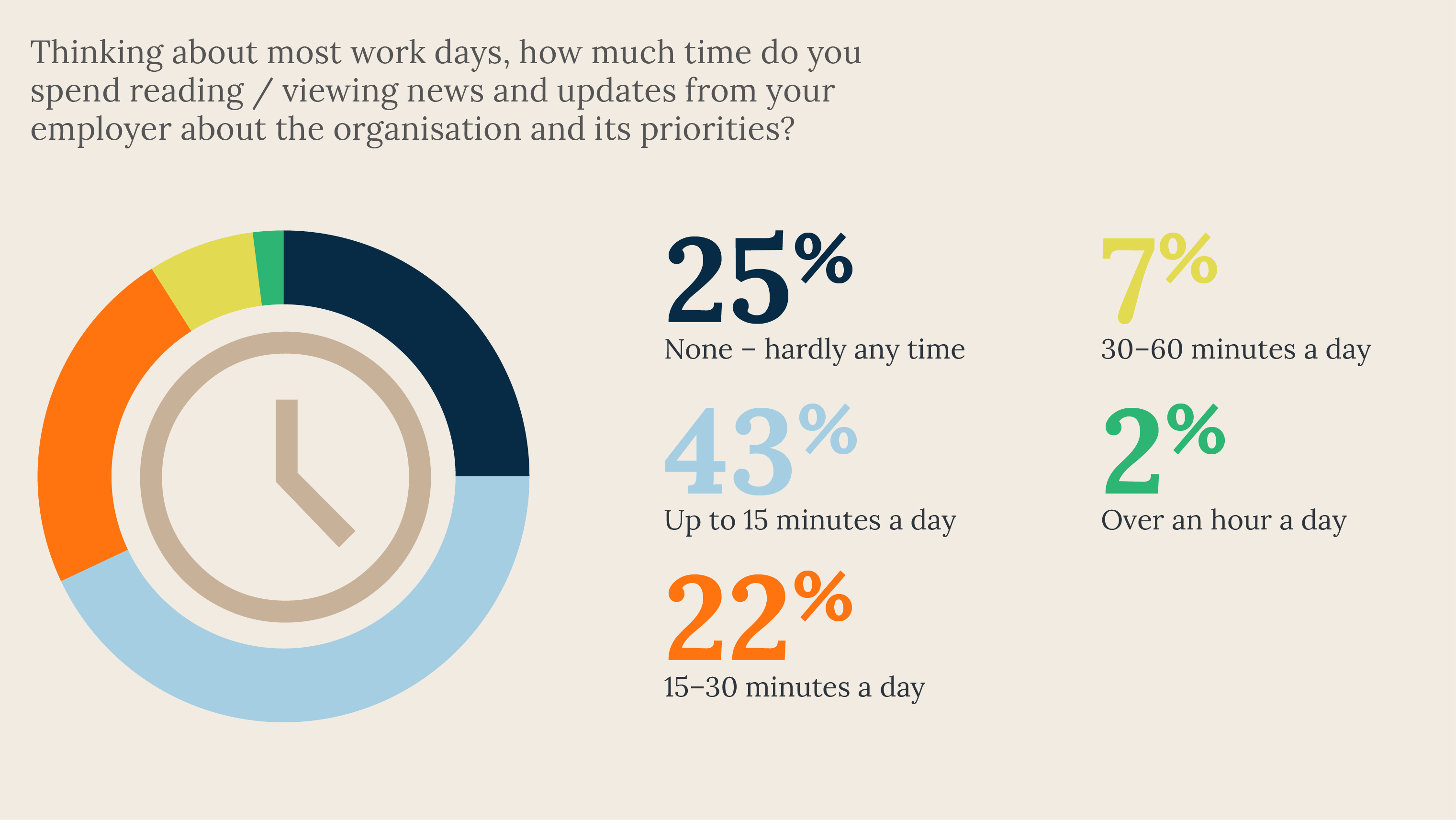
Indeed, 2024 internal communications research conducted by Ipsos Karian and Box, undertaken in conjunction with the Institute of Internal Communications, (see below) showed that employees spend no more than 15 minutes across a whole day reading or viewing internal communications from their employer.
This shows how much the attention economy inside organisations is brutally constrained. A quarter of employees spend virtually no time with corporate updates. Most of the rest give it minutes, not half-hours. Only a tiny fraction devote anything approaching sustained attention. In practice, the window leaders have each day to land a message is narrow and easily crowded out.
That reality forces a discipline many communication strategies avoid. If people are skimming, messages must be clear, relevant and immediately useful. Volume will not compensate for vagueness. When attention is measured in minutes, priority is earned by signal, not broadcast.
This is the cognitive-comprehension curve: information becomes exponentially harder to retain with every added layer of abstraction, jargon, formatting, or design flourish. This isn’t new science — it’s been proven again and again in behavioural research.
Ipsos Karian and Box’s communication work reinforces this. In multiple studies across sectors, employees report that the biggest barrier to clarity isn’t volume - it’s complexity masquerading as sophistication. Messages that should be one sentence become six paragraphs. Simple choices become branded frameworks. Straightforward decisions get wrapped in “journey narratives.”
Why corporate messages get so complicated
Because organisations mistake production value for substance.
Somewhere along the line, leaders started thinking a message is better when it’s longer, more polished, launched with cascading “toolkits” or accompanied by an explainer video “brought to you by Corporate Affairs”.
The irony? The more “professionally” a message is produced, the more likely employees are to dismiss it as corporate noise.
Ipsos Karian and Box internal communication research confirms this: messages perceived as “over-produced” correlate with low trust, low clarity, and low actionability - because employees recognise the spin.
What they want is simple: A) what is happening, B) what does it mean for me, and C) what do you want me to do?
When a message needs explanation, employees ask themselves one thing: what are they trying not to say?
Complexity signals one of three things:
Leadership is unsure but doesn’t want to admit it. So they wrap uncertainty in corporate theatre.
The decision is unpopular, so they’re softening the blow. Euphemisms are a red flag.
Someone senior insisted on adding their favourite slide. The curse of the “executive edit” with a Smorgasbord of corporate priorities and messages muddying the water.
The result? A message that says nothing clearly while pretending to say everything confidently.
The organisations that communicate well do the opposite…
There’s a misconception that great communicators are charismatic: they’re not. Great communicators are brutal minimalists. Stop wincing and ask yourself why Donald Trump is such an effective communicator.
High-trust organisations do three simple, powerful things:
They say one thing at a time. Not fifteen. One. One decision. One reason. One instruction.
They remove every unnecessary sentence. Internal messaging is a subtraction game, not an addition game.
They deliver the message in plain, human language. Not: “We’re entering a period of strategic recalibration to optimise cross-unit synergies,” but “We’re stopping Project X because it isn’t working.”
Greg Jackson, the founder and CEO of Octopus Energy, is a great example of a corporate communicator who ‘tells it as it is’, has a central theme he drives home, and does it in everyday language his people and his customers can understand. More leaders need to take a leaf out of his book.
Indeed, Ipsos Karian and Box research proves the point. It shows employees respond best to messages that are “short, transparently direct, and actionable.” Not inspirational or aspirational.
The 12-second rule
With only 15 minutes of attention span across a whole day, your message needs to hit home quickly. If it can’t be understood by a reasonably bright adult in 12 seconds, it’s not ready. Twelve seconds forces discipline:
What are you actually trying to say?
What’s the real decision?
What’s the real impact?
What do you want people to do?
If you can’t answer that concisely, you don’t have a message - you have a draft, and probably a crap one at that.
Every organisation thinks its complexity is special. None of them are. The companies winning are the ones rediscovering a radical truth: clarity is not a creative act - it’s a leadership act.
Fully agree and I’d push the diagnosis one step further: complexity in communication almost always reflects complexity in thinking.
The six-paragraph message with the branded framework and the cascade toolkit usually exists because the leader hasn’t yet made the hard choices that would allow him to say one simple thing and the communication team is then handed a brief that is fundamentally unclear and asked to produce clarity out of it; they can’t, so they produce volume instead.
The 12-second rule is a useful forcing function, but the real discipline happens earlier: you can’t say what you’re prioritizing and what you’re sacrificing in a single sentence, you haven’t finished the thinking.
Absolutely. Clarity, brevity, one message at a time.
I’d only add one thing: repetition. Even a simple message rarely lands the first time. It needs to be repeated across formats and moments: in a meeting room, in a follow-up email, in one-on-one conversations afterward.
Not more content, but the same message, repeated clearly. Clarity and repetition go together.