
Man Bites Machine
Ford fired the humans, hired the AI, broke everything, and then called the humans back. You may proceed to the departure lounge.

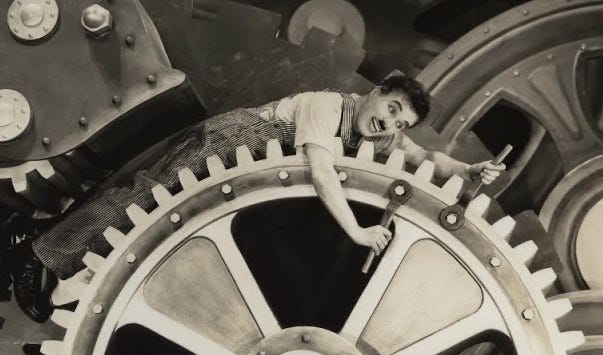
There’s a particular kind of corporate hubris that deserves its own taxonomy. It’s not ordinary arrogance, the stuff of missed quarterly targets or botched rebrandings. It’s the deeper, more operatic variety: the kind where a roomful of executives, intoxicated by the smell of their own disruption, decide that accumulated human knowledge built over decades is basically a legacy system waiting to be deprecated.
Ford Motor Company has just provided the case study of the summer.
Here is what happened, stripped of the spin. Ford, America’s second-largest automaker, spent several years betting that AI and automated quality systems could do what its experienced engineers had spent careers learning to do. In that time, the company cut over 5,000 employees and became the most recalled automaker in the United States. Its quality rankings dived. And somewhere in the executive suite, someone began quietly making calls.
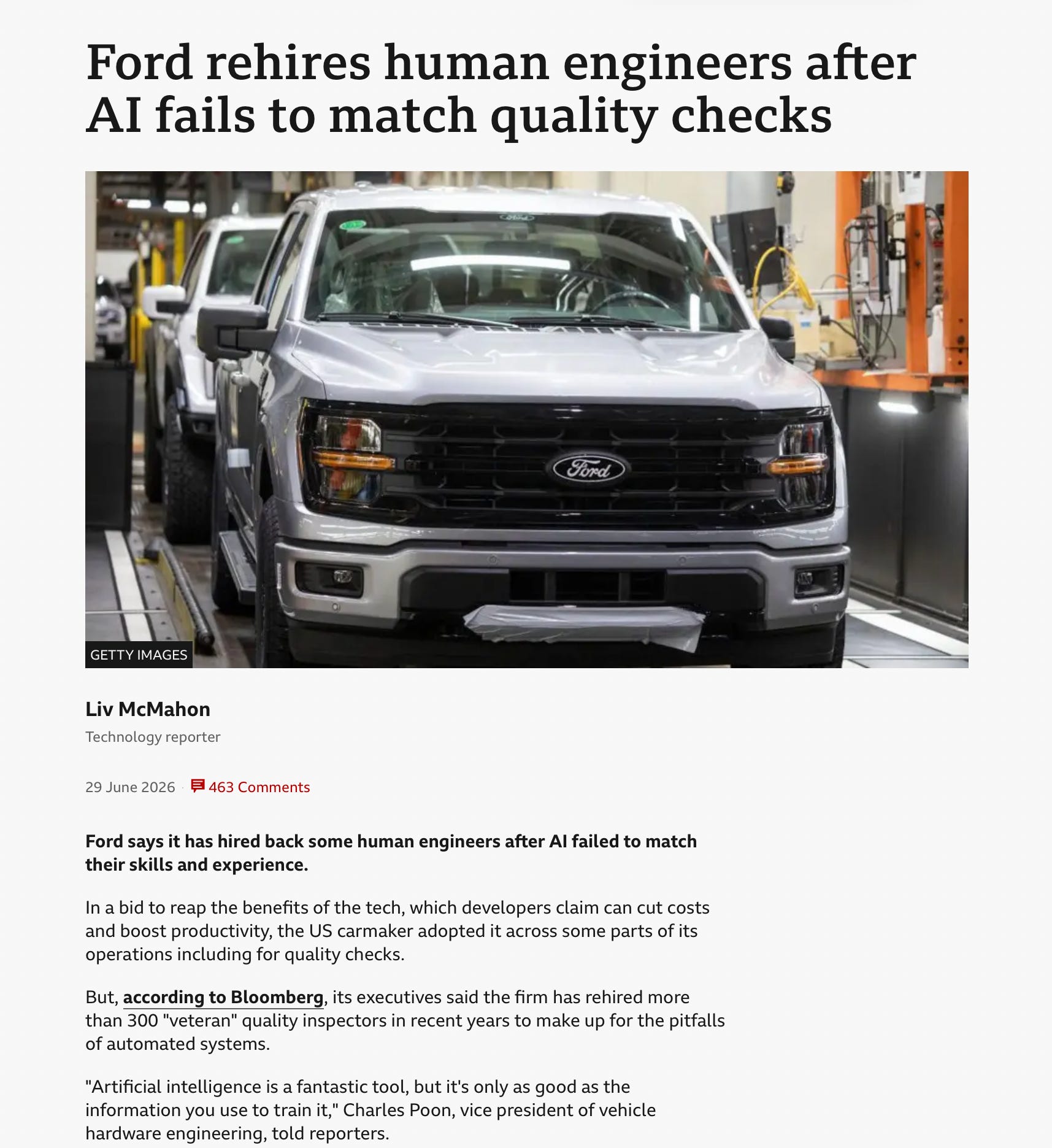
The company’s chief operating officer Kumar Galhotra told journalists that Ford had been “relying more and more on automated quality systems”, and with disappointing results. Ford’s VP of vehicle hardware engineering, Charles Poon, was even more candid: “Mistakenly, we thought that by just introducing artificial intelligence and adjusting the design requirements that we had, that that would produce a high-quality product.”
Mistakenly. A word doing a lot of heavy lifting there.
The fix required rehiring the specific people who carried institutional knowledge the AI never captured. These are the so-called “gray beards” - experienced engineers brought back to help train younger staff and reprogram the AI tools that weren’t getting the job done. In total, Ford hired 350 experienced specialists over three years to fix quality problems its automated systems couldn’t solve.
This is not a cautionary anecdote from a Luddite pamphlet. This is Ford Motor Company in 2026, admitting (with the press invited) that it got it wrong. And doing so, one notes, only after the numbers started turning around. Ford has since topped the JD Power 2026 Initial Quality Study among mainstream brands for the first time in years. CEO Jim Farley cited lowered warranty and recall costs “contributing to literally hundreds and hundreds of millions of dollars of a tailwind.”
Hundreds of millions of dollars. Recovered. By bringing back the people they had previously shown the door.
Now, I want to be careful here. I am not anti-AI. Large parts of my working life are genuinely better because of it. And Ford isn’t abandoning the technology either. Indeed, it has added more than 100,000 new AI-powered tests to identify edge cases and stress software systems. The story isn’t “AI bad, humans good.” The story is considerably more embarrassing than that.
The story is that companies are making decisions based on a fantasy. The fantasy goes something like this: expertise is essentially a database. If you can digitise the outputs of smart people, you can replicate the smart people. The humans become redundant. The savings are enormous. The shareholders applaud.
What the fantasy ignores, and what Ford has now paid billions to relearn, is that expertise is not a database. It is a living, relational, contextual thing, built from thousands of decisions made under pressure, in specific conditions, with specific materials, on specific production lines. It lives in the fingertips and the instincts of people who have been doing this for thirty years. It does not transfer cleanly into a training dataset. The experienced engineers left before transferring their institutional knowledge to the AI systems designed to replace them.
So here we are, approaching the summer of 2026, and the prevailing narrative (that AI is coming for all our jobs, probably by Thursday) remains extremely loud and only marginally more nuanced than it was three years ago. Every week brings a new think-piece, a new McKinsey report, a new breathless LinkedIn puff post from a founder who has “replaced his entire team with agents.”
Go on holiday.
Seriously. Book the flight, lock the laptop, eat something indulgent by a body of water. The robots will still be here in September. So, in all likelihood, will you.
The Ford story is not an anomaly. It is an early signal that the great human fire-sale is somewhat premature. It is, it turns out, rather the point. The grey beards knew things the machines didn’t, couldn’t, and can’t. They still do.
AI is genuinely brilliant. It is also, genuinely, a long way from finished. The organisations that understand the difference (that treat it as a powerful tool in skilled human hands rather than a wholesale substitute for skilled humans) are going to look rather smarter than Ford did circa 2023.
For now, though? Sunscreen. A novel. A complete moratorium on LinkedIn.
You probably still have a job to come back to. Ford’s engineers certainly did.