

The data shows a workplace splitting in two
Trust between employees and employers has been declining. But the most revealing finding relates to who trusts whom, and why the confidence gap by seniority is widening every year.


There is a version of the workplace trust story that most leadership teams believe. It goes something like this: our people broadly trust the organisation, there are some pockets of scepticism at the edges, and the important thing is to communicate clearly and consistently. The data, read carefully, tells a different story. It tells a story of a workplace fracturing along a seniority line (with senior leaders inhabiting one version of organisational reality and employees living in another) and a leadership class that is largely unaware the fracture is as wide as it is.
The evidence comes from multiple independent sources. Ipsos’ Global Trustworthiness Index 2024 (a 32-country survey of 23,530 adults) found that only 26% of the global public regard business leaders as trustworthy. To put that in context: ordinary people on the street score 38%. Business leaders are trusted less than lawyers, judges, and television news readers. They are trusted more than politicians — but that is a low bar, and a narrowing one.
Ipsos’ Global Trends research on strain and confidence at work compounds the picture. When employees are asked about their confidence in the future of their organisations, the gap between senior leaders and the rest of the workforce is a matter of kind. Senior leaders and frontline employees are, in material terms, living inside different versions of the same organisation.
The numbers that should end the complacency
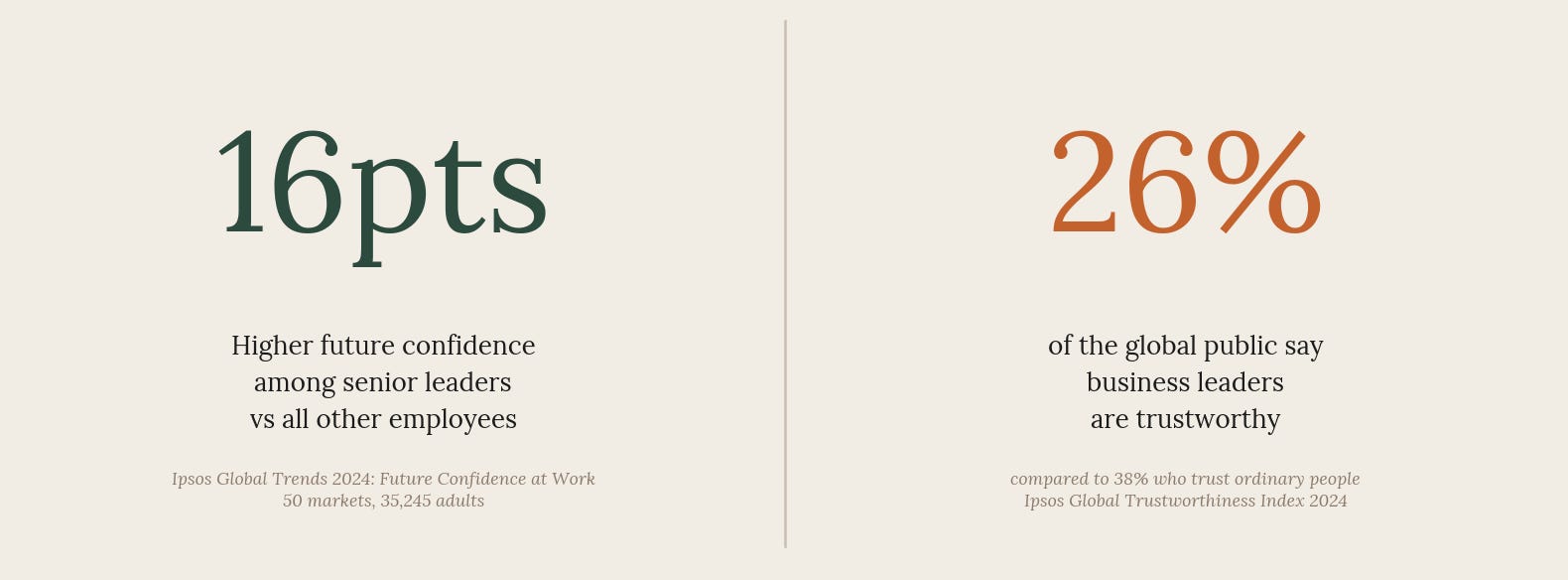
Ipsos’ 2024 Future Confidence at Work report (a 50-market survey of 35,245 adults conducted between February and April 2024) found a 16-point confidence gap between senior leaders and the rest of the workforce on the question of confidence in their organisation’s future. This represents a gap in the fundamental belief that the organisation they work for has a viable and positive future. Clearly, senior leaders are materially more optimistic about it than the people they lead.
The Ipsos report is explicit about why this matters: trust in business leaders is itself a key factor in future confidence. When employees don’t trust the people at the top to tell them the truth about where things are heading, their confidence in the organisation’s future falls. And that feeds directly into intent to stay, discretionary effort, and advocacy. The gap does not stay in the survey data. It walks out of the organisation in the form of the people who leave when better options appear.
Business leaders and the global trustworthiness deficit
The Ipsos Global Trustworthiness Index runs annually across 32 countries and asks respondents to rate the trustworthiness of a range of professions. The 2024 results, drawn from 23,530 adults, reveal a landscape that should concern anyone who leads an organisation (or advises one).
Who the Global Public Trusts: Trustworthiness by profession
Source: Ipsos Global Trustworthiness Index 2024. 23,530 adults across 32 countries, May–June 2024. % saying each profession is trustworthy.
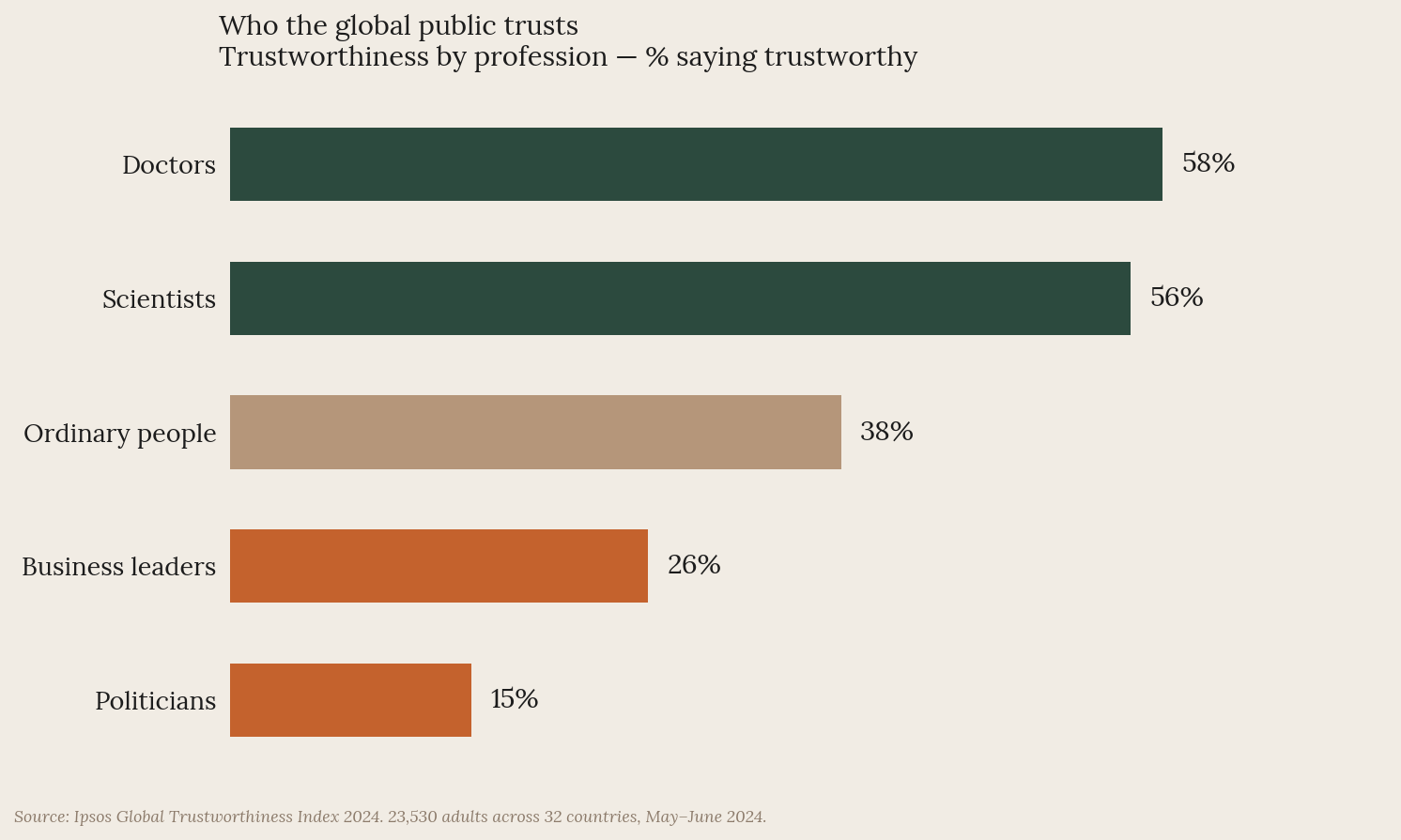
Chart insight: Business leaders score just 26% globally for trustworthiness — below ordinary people, lawyers, judges and TV journalists. They are rated more trustworthy than politicians, but the gap has been narrowing. This is the baseline trust environment in which every corporate communication lands.
The Ipsos Karian and Box’ own Strain at Work analysis, also from 2024, puts the business leader figure starkly: only 23% of the global public say business leaders are trustworthy. This provides the global baseline against which every all-hands presentation, every CEO video, and every internal messaging campaign operates. Most internal communication is being received by people who do not, as a starting point, trust the person delivering it.
This has specific consequences for how organisations should think about their communication strategy. The instinct (to communicate more, more frequently, with more polish) misreads the problem. The issue here is credibility, not volume or production quality. And credibility is not rebuilt by a better cascade but by sustained pattern of saying true things and then being seen to act on them.
The communication gap that makes it worse
A previous edition of the Ipsos Karian and Box IC Index (surveying 4,000 UK employees in 2024, partnership with the Institute of Internal Communication) has documented the internal consequences of this trust environment with precision. The finding that carries most weight is a 74-point trust gap between employees who rate their organisation’s internal communication as excellent, and those who rate it as poor. Trust and communication quality are not loosely correlated. They move together with a near-deterministic relationship.
Communication quality and leadership trust
Source: Ipsos Karian and Box IC Index 2024 (IoIC). 4,000 UK employees. Trust in leaders score by internal communication quality rating.
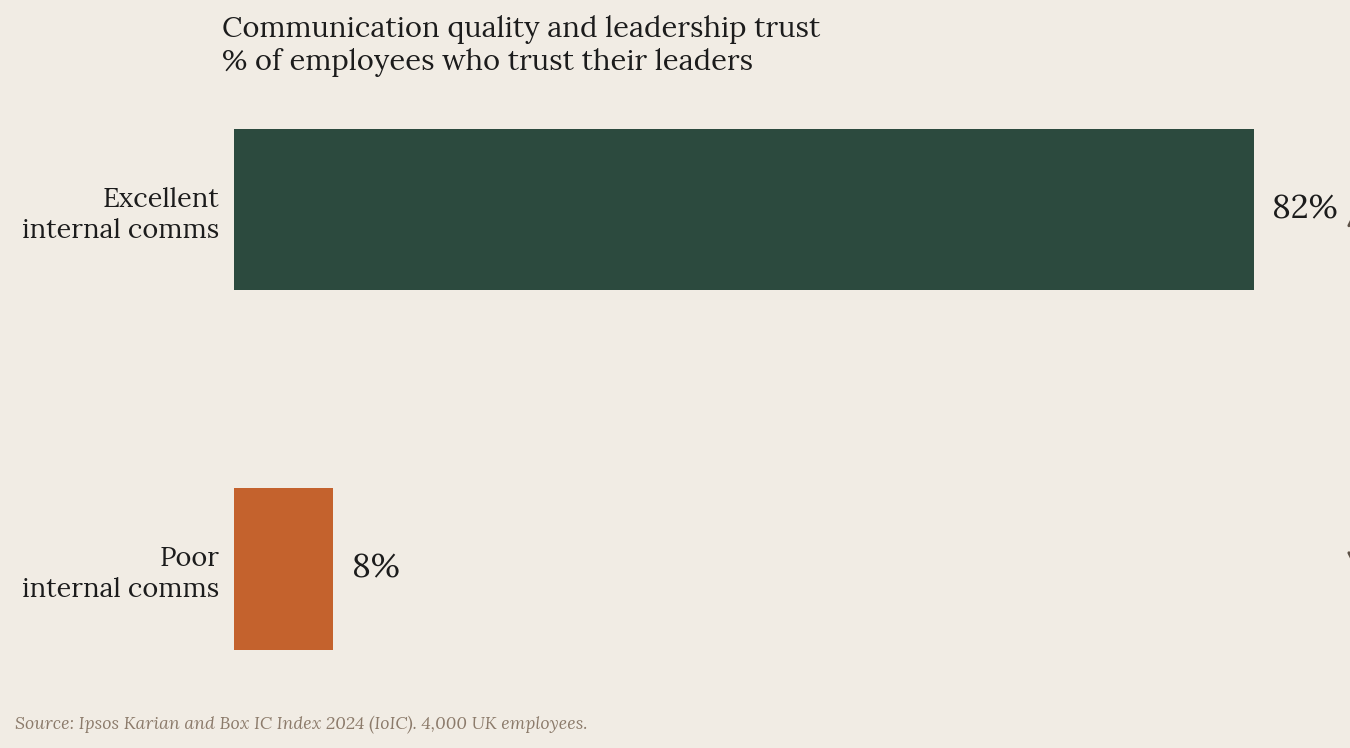
Chart insight: A 74-point gap in trust in leaders between employees who experience excellent internal communication and those who experience poor communication. This is not a marginal effect — it is the largest single lever available to organisations seeking to rebuild trust. And it costs nothing except honesty.
The same IC Index 2024 research found that only 43% of UK employees believe their organisation acts in their best interest. 68% felt their organisation had been dishonest about the reasons for returning to the office — a single issue that, in Ipsos Karian and Box’s analysis, left a residue of scepticism that outlasted the immediate decision. Organisations that are dishonest about small things train their people to distrust them about large ones.
Indeed, the 2025 edition of the IC Index study (drawing on 4,939 UK workers surveyed in March and April 2025) reinforced the direction of travel. Employees, in the words of the report, are tired of distant leadership and vague, impersonal messaging. What moves the needle on trust is authenticity, care, and the visible willingness of leaders to listen — and to be seen to have listened.
The seniority gap in confidence and what it produces
The 16-point confidence gap between senior leaders and the rest of the workforce documented in Ipsos’ Global Trends 2024 research is not symmetrical in its consequences. Senior leaders who feel confident about the future communicate in the register of that confidence. They use the language of opportunity, trajectory, and momentum. The employees on the receiving end, whose confidence in the organisation’s future is materially lower, experience that language as disconnected from their own reality. Worse, they see it as evidence that leadership doesn’t understand what is actually happening in the organisation.
The Confidence Divide — Senior Leaders vs All Other Employees
Source: Ipsos Global Trends 2024: Future Confidence at Work. 35,245 adults across 50 markets, February–April 2024. Proportional representation of 16-point confidence gap between senior leaders and all other employees.
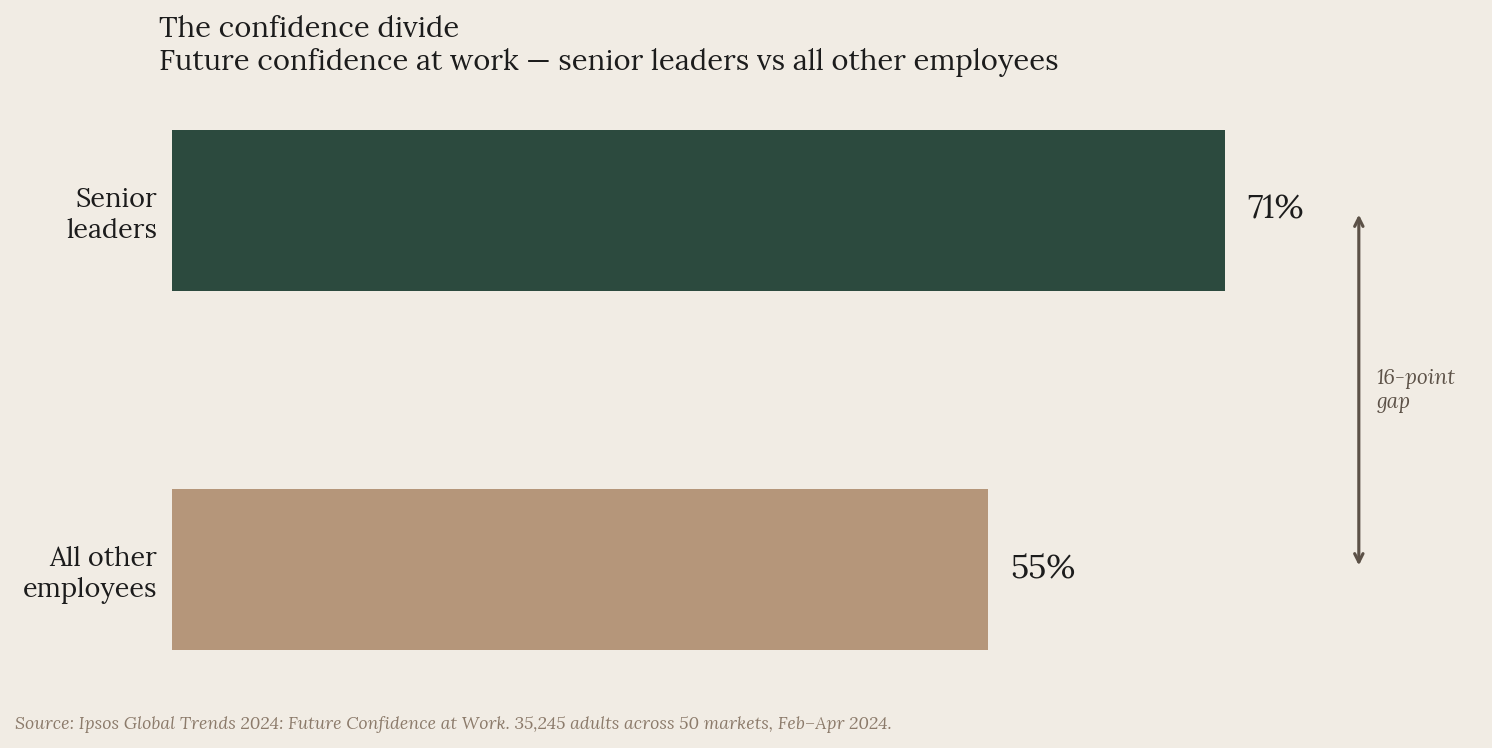
Chart insight: Senior leaders are significantly more confident about their organisation’s future than the employees they lead. This gap doesn’t just exist in survey data — it shapes every interaction: how strategy is communicated, how decisions are explained, and whether employees believe what they are being told.
Ipsos’ analysis is direct about the mechanism: the gap between perceptions of senior leaders and the rest of employees is exacerbated by the fact that trust in business leaders is itself a key factor in future confidence. The two variables reinforce each other in a negative loop. Low trust in leaders reduces employee confidence in the organisation’s future. Low confidence reduces engagement, advocacy, and intent to stay. The departure of engaged employees further erodes the institutional knowledge and relationships that genuine future confidence depends on.
Senior leaders are 16 points more confident about their organisation’s future than the people they lead. They communicate in the register of that confidence. Employees on the receiving end experience that language as disconnected from their reality — or as evidence that leadership doesn’t understand what is actually happening.
Where trust actually lives and what that means practically
Across all the Ipsos research on workplace trust, one finding is consistent enough to be treated as structural rather than incidental: trust in organisations is built at the local, human level (in the direct manager relationship, in team dynamics, and in the quality of peer relationships) far more reliably than it is built through official communication channels.
The IC Index 2024 finding that only 43% of UK employees believe their organisation acts in their best interest is a leadership-level indictment. But it sits alongside data showing that trust in direct managers, while declining, remains considerably higher than trust in senior leadership. The credibility chain runs upwards from the front line, not downwards from the boardroom. Employees trust the people they can observe closely, whose behaviour they can verify against their words. Senior leaders operate at a distance at which that verification is difficult, which means their trust is more fragile, and more dependent on the consistency between what they say and what demonstrably happens.
The practical implication is not complicated, even if its execution is. The organisations that rebuild trust most effectively are those that invest in their line manager populations. They give them the context, the support, and the permission to have genuinely honest conversations with their teams rather than cascading filtered versions of official messaging. They are the ones that close the 74-point gap by improving the quality of what they actually say and whether it can be believed.
The data is clear on the scale of the problem. It is equally clear on what resolves it. The only question is whether the people with the authority to act on that evidence are willing to acknowledge that the primary obstacle to rebuilding trust in their organisation is the way they themselves have been leading it.
Sources
Ipsos (2024). Global Trustworthiness Index 2024. 32-country survey of 23,530 adults, conducted 24 May – 7 June 2024, via Ipsos Global Advisor. Business leaders: 26% trustworthy globally. Ordinary people: 38% trustworthy. Politicians: 15% trustworthy (joint least with social media influencers in 2025 edition). ipsos.com/en/ipsos-global-trustworthiness-index-2024
Ipsos Karian and Box (2024). Global Trends 2024: Strain at Work. 35,000+ adults across 50 markets. 23% of the global public say business leaders are trustworthy. ipsoskarianandbox.com/insight/73/global-trends-2024-strain-at-work
Ipsos / Ipsos Karian and Box (2024). Global Trends 2024: Future Confidence at Work. 35,245 adults surveyed across 50 markets, 15 February – 23 April 2024. 16-point confidence gap between senior leaders and all other employees on confidence in organisation’s future. Trust in business leaders is a key factor in employee future confidence. Significant disconnect between how leadership views employee experience and reality on the ground. ipsoskarianandbox.com/insight/74/global-trends-2024-future-confidence-at-work
Ipsos Karian and Box / IoIC (2024). IC Index 2024: The Trust Issue. 4,000 UK employees. 74-point trust gap in leadership trust between those experiencing excellent vs poor internal communication. Only 43% of UK employees believe their organisation acts in their best interest. 68% felt their organisation was dishonest about reasons for returning to the office. ipsoskarianandbox.com/insight/71/ic-index-2024-trust-issue
Ipsos Karian and Box / IoIC (2025). IC Index 2025: Leading with Care and Connection. 4,939 UK workers surveyed 21 March – 4 April 2025. Employees are tired of distant leadership and vague messaging. Authenticity, care, and genuine listening are the primary drivers of trust — not communication volume or channel sophistication. ipsoskarianandbox.com/insight/90/ic-index-2025-leading-with-care-and-connection
When we hear so much about authentic leadership - seems a key component is missing in action.
This is the part many leadership teams miss: distrust is not a communications problem first.
It is a consequence problem.
People do not need more polished messages if daily reality keeps contradicting them. Trust returns when ordinary employees can see the same standard applied upwards: tell the truth, name the trade-offs, correct what fails, and let consequences reach status.
Without that, “alignment” just becomes a nicer word for asking people to pretend.