

Understanding why corporate transformations fail
Businesses now transform every two years, but most treat change as a communications exercise. Real adoption happens when leaders simplify the work, absorb the pain, and make trade-offs visible.

According to McKinsey, twenty years ago, a new CEO came around (on average) once every 8 years. Now, it’s every 5 years. And, with global topline growth stagnating for many corporations, they turn to driving up profits to satisfy shareholders who want a return on their investment. As a result, companies institute major organisational change much more regularly than ever before. Again, McKinsey state that large-scale corporate change happens once every 2 years now – compared with once every 4-5 years 20 years ago.
This means that effective change management needs to be the new superpower of HR and communications professionals. Or it will be the kryptonite that brings them down.
New CEOs love instituting major, strategic change. It’s what they get paid the big bucks for. Or, at least, they love the idea of change: big visions, bold announcements aimed at dividend-hungry shareholders, and video montages with crescendos.
Employees, by contrast, love functioning systems, clear expectations, and not being yanked from one half-baked strategy or change initiative to the next.
So, we get the current pattern: change launched from the top, resistance from the middle and bottom, and then expensive consulting reports explaining why it all went wrong.
For decades, the business world has repeated that “around 70% of change efforts fail.” The exact figure is debatable, but large-scale research from places like McKinsey consistently shows that employee resistance and behaviour are reported as the top reasons transformations struggle, far more often than “bad frameworks” or “insufficient analysis.”
Ipsos Karian and Box studies across multiple businesses undergoing organisational change makes the same point from the employee side. Engagement and culture scores drop hardest when people feel change is done to them, not with or for - especially when the benefits are abstract and the pain is immediate.
Why employees “resist” (and why they’re often right)
It’s fashionable for leaders to frame resistance as emotional immaturity and a lack of resilience in a world where change is constant. “People just don’t like change.”
No. I don’t believe people dislike change. They simply don’t like bad, chaotic or cosmetic change. Or change that makes their jobs harder for reasons no one can explain.
Common reasons employees push back:
The change adds work but removes nothing. New processes on top of old ones. New systems with old systems kept “just in case.” Change that piles on, rather than replaces.
The rationale is vague or dishonest. “We’re on a journey” is not a business case. Employees can tell when the real driver is cost-cutting, power consolidation, or executive vanity.
They weren’t involved early enough. People asked to implement a change they had no say in are less likely to commit to it, especially if they see obvious flaws.
They can see operational landmines leadership has chosen to ignore. Frontline employees resist because they see what will actually happen on Monday morning.
Academic work on resistance shows it can be a rational response to poorly designed change - a warning signal, not a character defect.
The leadership delusion
Leaders often believe: “If we just communicate the vision better, people will come around.” So, they commission more messaging. Town halls. Animated videos. FAQ packs. Internal campaigns with their own logos.
Ipsos Karian and Box research into internal communication and change consistently finds this fails when the underlying design is flawed. No amount of storytelling compensates for extra workload, unclear responsibilities and unresolved conflicts or misaligned incentives. You can’t communicate your way out of a bad trade-off.
What successful change actually looks like
In organisations where change sticks, a few patterns repeat:
Employees understand the problem, not just the “journey”. Leaders spend more time explaining what’s broken and less time naming the programme.
There is visible removal of friction. Some tasks are simplified or eliminated before new ones appear. People see a net gain, not a net burden.
Early input is real, not performative. Ipsos Karian and Box’s work shows engagement and trust remain higher when employees can shape how change is implemented, even if they can’t veto what changes.
Leaders change first. If the transformation requires new behaviours, executives adopt them visibly before asking others to.
Trade-offs are explicit. People are more likely to accept pain when leaders are honest about who loses, who gains, and why.
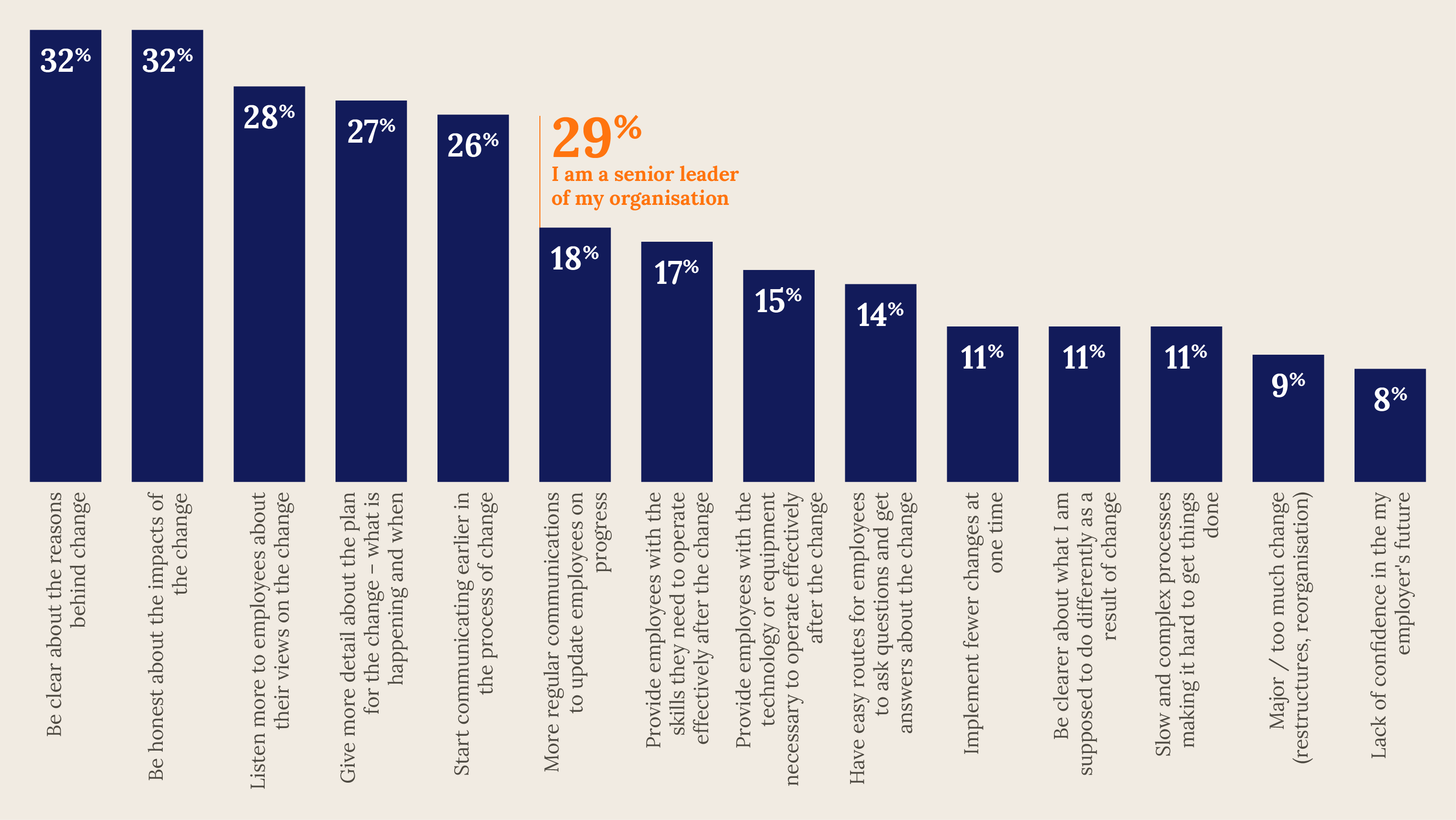
Ipsos Karian and Box research (see below) highlights that employees are consistent about what they want during change. At the top of the list sit clarity and honesty: explain why this is happening, be straight about the consequences, and involve people early enough that their views can shape the outcome. After that come the mechanics — detail on timing, visible progress updates, and practical help to operate in the new world. The message is simple: uncertainty is tolerable when direction is credible.
What is easy to miss is the gap in perspective. Nearly three in ten senior leaders believe they are already providing what is needed. Yet the frequency of requests for better explanation, earlier communication and more listening suggests many employees disagree. The challenge, therefore, is less about inventing new initiatives and more about closing the experience gap between intent and reality.
What UK employees want during periods of change (Ipsos Karian and Box, 2024)
If you strip away the rhetoric, most corporate change is an unattractive offer to employees: “Please accept more ambiguity, more work, and more risk to your role in exchange for an abstract future benefit you may or may not see.” No wonder they “resist.”
If you want employees to want change, you have to reverse that equation. Reduce friction early, improve something tangible now, involve people meaningfully, and stop pretending every change is a “once-in-a-generation opportunity.”
Most change doesn’t fail because employees are stuck in the past. It fails because leadership isn’t honest (or brave) enough to design a future that’s actually better for the people expected to build it.