

Whether you call it ‘retrenchment’ or cuts – it means the same thing
How companies are cutting without calling it cuts - and what the survivor data tells us about who really pays the price.

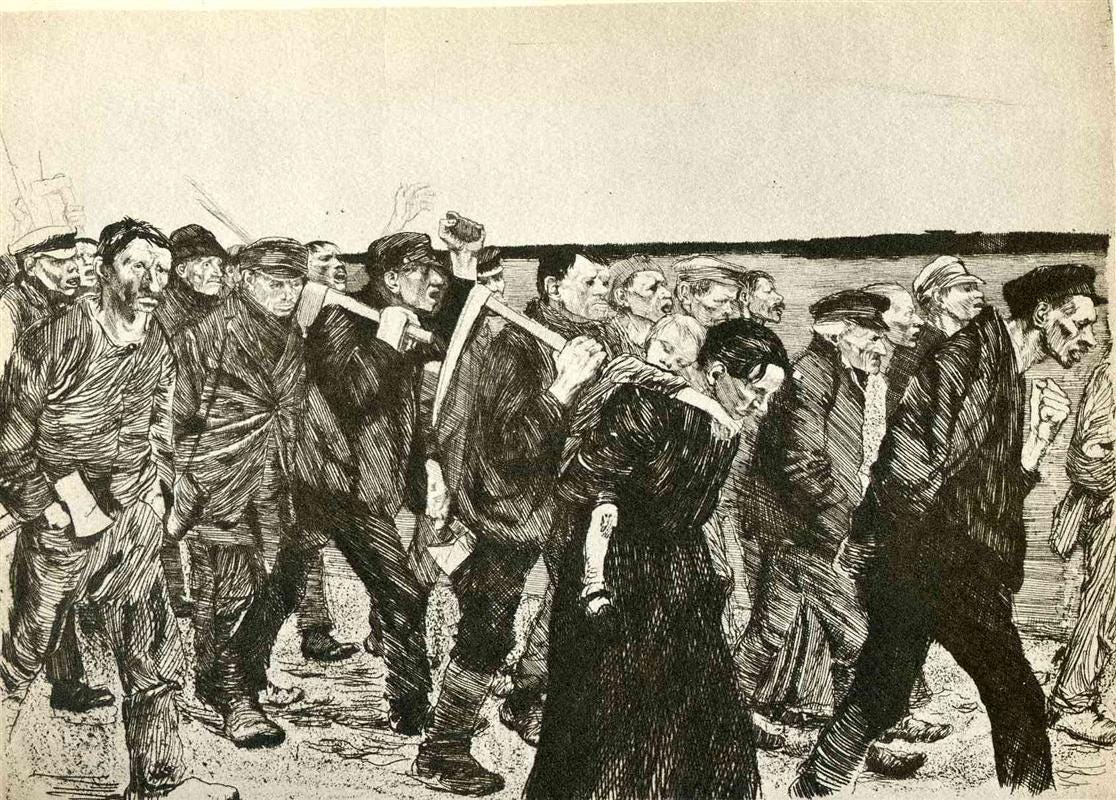
Redundancy has a vocabulary, and most of it is designed to obscure what is actually happening. ‘Restructuring for efficiency.’ ‘Optimising our organisational design.’ ‘Aligning headcount with strategic priorities.’ These are the sentences that appear in the all-hands presentation before the numbers appear. And then there is the category of workforce reduction that never makes it into a formal announcement at all.
‘Quiet retrenchment’ is the pattern of cost reduction that organisations pursue when they want the financial outcome of redundancy without the reputational exposure, the legal complexity, or the acknowledgement that something significant has changed. It operates through a taxonomy of mechanisms that are individually unremarkable and collectively corrosive: frozen salaries that fall behind inflation in real terms; roles that are quietly redefined downward; performance management processes that are used as structured exit routes; headcount that is ‘not replaced’ when someone leaves. The organisation hollows out behind a façade of business as usual.
While the practice is not new, the scale at which it is currently operating (in a cost-pressured, growth-constrained economy navigating geopolitical disruption) is. Indeed, according to Ipsos Karian and Box / IOIC research in 2026, over a third of UK workers have said their employers are making redundancies – with half also saying some form of re-structuring or change is taking place at work.
The taxonomy of the invisible cut
It is worth naming the mechanisms clearly, because their individual plausibility is part of what makes the pattern difficult to challenge.
The salary freeze is perhaps the most common. Presented as a prudent response to economic uncertainty, a multi-year pay freeze in a period of even moderate inflation is a real-terms pay cut. Employees who joined on a market rate find themselves, two or three years later, materially below it. The highest-performing ones, who have the most external options, leave. The organisation retains, disproportionately, those with fewer alternatives.
The role redefinition is subtler. A senior role is re-banded while responsibilities are quietly narrowed. The person in it is invited to take on a ‘refocused’ brief that happens to be two grades below what they were recruited to do. They are managed out through accumulated diminishment.
The performance improvement plan, in its current widespread deployment, deserves particular attention. PIPs were originally designed as genuine development tools: structured, time-limited interventions to help employees improve specific performance deficits. In practice, many are now used as documented exit routes: a process that creates a paper trail justifying a separation that the organisation had already decided to pursue, while avoiding the cost and complexity of a redundancy process.
None of these mechanisms is, in isolation, illegal. Together, they constitute a pattern that most employees recognise and most organisations decline to acknowledge.
The survivor problem
The research on what happens to the people left behind after organisational downsizing is extensive, consistent, and almost entirely ignored by the organisations that most need to read it.
Professor Joel Brockner of Columbia Business School has studied layoff survivor reactions for nearly four decades. His consistent finding: survivors develop what he terms a cocktail of negative emotions (anger, depression, fear, distrust, and guilt) that produces reduced productivity, increased absenteeism, and a heightened propensity to leave voluntarily. A Canadian health sector study found that employees who found new jobs after being laid off were, by most measures, better off than the colleagues who survived the process. The survivors experienced higher stress, less autonomy, lower job satisfaction, and lower quality of life. The irony, as one research paper put it, is that ‘survivors were the victims.’
Professor Joel Brockner has studied survivor reactions for nearly four decades. His finding: survivors develop a cocktail of anger, depression, fear and guilt that produces reduced productivity, increased absenteeism, and a heightened propensity to leave. The irony, one study concluded, is that the survivors were the victims.
This matters commercially because the people most likely to leave voluntarily after a restructuring are the people with the most external options; which is to say, the highest performers. The ones who stay are, disproportionately, those who are either more risk-averse or less marketable. The organisation that cuts its way to short-term financial improvement and retains a workforce selected, effectively, by who chose not to leave, has simply deferred and compounded its’ problems.
The honesty deficit
The evidence on how organisations can manage restructuring without destroying the cultures they depend on points consistently in one direction: honesty, exercised early and maintained consistently, produces materially better outcomes than managed ambiguity.
Employees, it turns out, can process bad news. What they cannot process (and what the trust data consistently reflects) is the gap between what they were told and what was true. No wonder the 2026 Ipsos Karian and Box / IOIC study in 2026 mentioned earlier has shown trust in senior leaders and CEOs plummet.
The Airbnb response to its 2020 pandemic redundancies is widely studied as an example of the alternative. CEO Brian Chesky’s communication to departing employees was direct about what was happening and why, specific about the support being provided, and honest about the company’s uncertainty. Survivor accounts consistently identify that transparency as the factor that made the process survivable.
The organisations that are currently pursuing quiet retrenchment at scale are, in many cases, betting that the managed version of their reality will hold long enough to avoid accountability. What the research suggests is that it will not, and that the cultural cost of the attempt (the erosion of trust, the departure of the high-performers, the loss of whatever psychological contract once existed) will outlast the financial pressures that produced it.
Honesty about organisational constraint is an essential leadership competency. And like most leadership competencies, it is in shorter supply than most job descriptions suggest.
Sources
Brockner, J. (Columbia Business School). Research spanning nearly four decades on layoff survivor reactions. Consistent finding: survivors develop anger, depression, fear, distrust and guilt; resulting in reduced productivity, increased absenteeism, and heightened voluntary turnover. Brockner J., Davy J. & Carter C. (1985). Layoffs, self-esteem, and survivor guilt. Organizational Behavior and Human Decision Processes, 36, 229–244.
Canadian health sector study on layoff survivors vs. those who found new employment. Finding: those who found new jobs were better off on stress, autonomy, job satisfaction, and quality of life than those who survived the downsizing. Cited in Welcome to the Jungle (2024), ‘Left behind: Breaking the silence around survivor guilt in the wake of mass layoffs.’
Careerminds (2025). Improving Career Transition Support report, with research agency Adience. Documents voluntary turnover increase among layoff survivors; disengagement, burnout, and trust erosion as consistent post-downsizing outcomes. careerminds.com
Edelman Trust Barometer (2025). Employer trust fell 3 points — the sharpest single-year decline in 25-year history. edelman.com/trust/2025/trust-barometer
MDPI / Sustainability (2023). ‘The Experiences of Layoff Survivors’. Qualitative research documenting survivor syndrome: guilt, heightened anxiety, motivation collapse, and trust erosion. Airbnb (2020) cited as best-practice case study in transparent restructuring communication. mdpi.com/2071-1050/15/24/16717