

Middle managers are becoming the most burned-out role in the western economy
Data shows the people holding organisations together are the ones breaking fastest. The fix? Redesigning the role before the entire system buckles.

If you were asked to guess the most exhausted population in the modern workforce, you might aim high: CEOs, CFOs, founders, tech engineers. You’d be wrong. The people burning out fastest are the people in the middle - the corporate ‘subclass’ known as middle managers.
Workplace research from Ipsos and Ipsos Karian and Box, alongside global wellbeing studies, paints a consistent picture: middle managers are the most strained, emotionally depleted, and operationally overloaded job category in contemporary organisations.
Ipsos Karian and Box’s employee experience benchmark database (one of the largest in Europe) shows middle managers reporting significantly lower scores on role manageable workload, influence over decisions and wellbeing.
Experience of positive work life balance (Ipsos Karian and Box research, 2023 and 2025) - across seniority levels, from the most junior (level 2) through to the most senior (levels 6 and the C-suite / Exec)
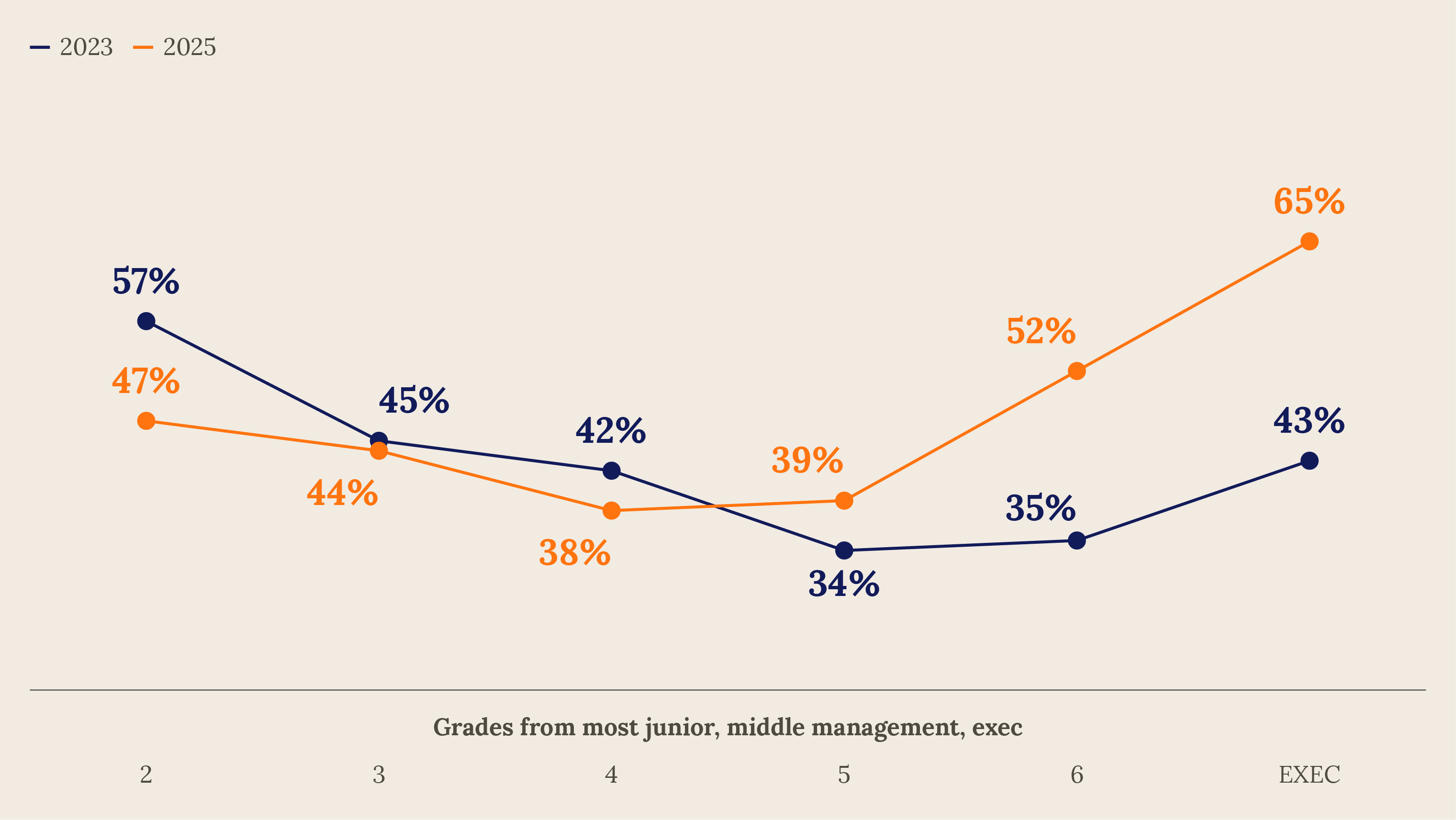
The eye is drawn to the middle. In both periods, the weakest experience of balance sits not with the most junior or the most senior, but with managers in between. By 2025 that pattern has sharpened: while executives report a marked improvement, the centre remains comparatively squeezed.
This makes practical sense. Middle managers continue to absorb demand from above and below at the same time. They carry delivery, translation, people care and ever more change, often without the authority to reduce any of it. Responsibility rises faster than control, and balance erodes accordingly.
The danger is cumulative. When the middle is stretched, the organisation’s shock absorbers wear out. Support for teams weakens, execution slows, and senior intent struggles to land. Protecting wellbeing of middle managers is critical, helping build infrastructure deep into the organisation. If organisations want resilience, the answer is unlikely to be another wellbeing initiative aimed at individuals. It will be fewer simultaneous priorities, cleaner decision rights, and protection of managerial capacity. Without that, the very cohort relied upon to steady everyone else will remain the most destabilised of all.
Why is this? Because the middle manager role has quietly become structurally impossible.
1. They carry responsibility without authority
Middle managers are accountable for outcomes but often excluded from shaping the decisions that define those outcomes. Ipsos Karian and Box leadership diagnostics regularly reveal the same theme: managers feel “responsible for everything but empowered for nothing.” This is a trap, especially during periods of change – with a new strategy dictated from the top but which they have the responsibility of implementing.
2. Hybrid work multiplied their coordination load
Before 2020, managing meant overseeing people in one place. Now it means orchestrating teams across locations, time zones, work patterns, and digital channels - with no additional capacity. Ipsos Karian and Box research on hybrid work in 2023 stressed the increase in communication load, context switching, and manager-mediated problem solving. Middle managers became traffic controllers. And the traffic keeps increasing.
3. They’re emotional shock absorbers
Employees escalate stress upward to managers who also have to deal with the downward pressure from senior leaders. They sit between two emotional weather systems. Multiple HR and wellbeing studies show that managers handle the majority of employee wellbeing issues - despite lacking training, time, or organisational support.
4. Admin is eating their role alive
Most middle managers spend their weeks administrating, not leading. Scheduling, reporting, chasing updates and approvals. Filling in dashboards while also recording “evidence of development conversations.” Role-design research shows middle managers spend significant proportions of their day-job on admin-heavy tasks, not on coaching, feedback, or capability building.
5. The role is outdated
Middle management was designed for a world that no longer exists. Gone are the stable hierarchies and predictable workflows. Hybrid now limits in-person oversight. Matrix working fudge clear spans of control and linear decision cycles. Work is now fluid, ambiguous, accelerated, and digitally mediated. As a result, middle management roles have evolved from “team leader” to “mini-CEO of chaos” leading to burned-out managers, in turn creating burned-out teams.
Multiple Ipsos Karian and Box studies have shown that where managers lack clarity and capacity, employee engagement, trust, and performance collapse. Teams led by overwhelmed managers show lower energy, lower role clarity and higher turnover intention with slower change adoption.
This is because the system has made performing impossible. Fixing the manager crisis requires redesign, not pep talks.
Forward-thinking organisations are already making changes.
1. Reduce span of control
Fewer direct reports driving better team coaching, enablement and support. This challenges the lunacy of one-size-fits-all dictates from the likes of Bain & Co or McKinsey. It doesn’t mean one-to-two reporting ratios but making more sensible adjustments for the real world in which middle managers operate.
2. Remove administrative load and give managers real decision rights
This includes using the latest AI solutions to automate reporting and scheduling / workload management. It also focuses on eliminate pointless approvals – requiring more a cultural rather than technological adaptation.
3. Set fewer, clearer priorities
Ambiguity is a burnout accelerant.
3. Provide practical, not performative, support – and set clearer priorities
Managers need practical tools and skills that help bold resilience. But, they also less nonsense to be resilient about. Ambiguity is a burnout accelerant and so leaders need to be much clearer which priorities are the most important so managers can focus the limited number of waking hours on those.
The Western economy runs on the middle layer
They are the translators, integrators, coordinators, escalators, problem-solvers, buffers, and human shock absorbers holding companies together. Burn them out and the whole system collapses. Fix their roles and productivity, wellbeing, and trust rise fast.
The way we design the role of middle managers is the problem - not the middle managers themselves. And fixing it is one of the highest-leverage organisational decisions any leadership team can make.